Showing posts with label Quickies: My Brief Thoughts on Certain Movies. Show all posts

Wednesday, April 27, 2016

Eternal Sunshine of the Spotless Mind

So, last week my Psychology teacher had us watch Eternal Sunshine of the Spotless Mind in class, then for our homework we were supposed to write a short review.  But, by way of the Secret Arts of Procrastination, I find myself just now sitting down to write this review...

...only to find that my computer battery is dead and I didn't bring the charger with me today.

So, instead of leaving the glorious privacy of the empty classroom I'm currently situated in, I'm going to write my review here (since I can access Blogger from my phone).  Besides, it is media related, so why not share my thoughts with the rest of you as well.

So, here we go:

Psychology: Eternal Sunshine of the Spotless Mind

The story begins with an apathetic man who skips work and ends up running into an enthusiastic woman with blue hair.  They end up hitting it off and soon commit to some kind of a relationship.  But as the film progresses, we discover that they were both previously in a relationship, but broke up and decided to have their memories erased so as to avoid the painful memories.  As the man undergoes the memory wiping procedure, however, he realizes that the good memories of his former girlfriend are being attacked as well.  Panicked, he goes to extraordinary lengths to keep her (or the memory of her, anyway) from being completely erased. 

Fighting back from the outside are a doctor, his lab assistant and office clerk (who are secretly in love with each other and engage in sex over their patient's sleeping form).  Also there to complicate matters further is the lab assistant's assistant who has developed a crush on the main character's former girlfriend and is using the main character's memories to woo her.

Yup, quite the complicated storyline.

Since this is for a psychology class, I'm assuming I need to spend some time discussing the psychology interwoven into the movie as well as the psychological effects it had on me (or my response to it), so here we go.

It's interesting how much we wish we could forget sometimes, and I think the movie does a good job of comforting that desire head-on.  Yes, some memories can be painful and we may think that the only liberation we can get is if we rid ourselves of those memories.  But those bad memories contribute to our growth and maturity.  If we were to retrace our steps, we would find that those painful memories had just as much influence in making us who we are today as the good memories.

For example, my Mom dying of cancer is a bad memory of a difficult time in our family.  But as much as I wish it hadn't happened or that I could forget it, I know for a fact that I would not be the woman I am today.  I wouldn't be driving myself, I wouldn't know the meaning of the word "independent thought", I wouldn't be this close to publishing my book, I wouldn't be attending the Art Institute, and I probably wouldn't have started this blog.  And I definitely wouldn't have seen The Force Awakens seven times in the theatre  (my Mom was a bit controlling).  Because of her death, I'm more independent than I probably could have been if she was still alive.  Do I still get sad when I think about her?  Heck, yes!  I still break down whenever someone sings her favorite hymn.  Do I wish I could forget her?  No.

Back to the movie.

Overall, this wasn't my favorite movie.  Believe it or not, it was a little too weird for me (and that's saying something coming from the girl who loves Roald Dahl and The Series of Unfortunate Events).  But I did like how it touched on mankind's desire to be rid of pain.

As humans, we don't like to be in pain or discomfort.  It's our natural inclination to make pain go away (unless you're a sadist, but that's a whole different beast in and of itself).  If there's a cactus prickle in our feet, we're naturally inclined to want to pull it at as soon as possible.  I think it's the same with memories.  It's our natural inclination to make the pain stop by getting rid of the source, but we have to realize memories don't work that way.  Depending on the functionality of our minds, memories can be stuck with us for the rest of our lives.  If we could have them physically removed, I think we would.  I think Eternal Sunshine of the Spotless Mind tackles that desire and says, "Yes, we all want to live a pain-free life, but if given the choice of losing all the memories of a person, place, or event, would we really choose to lose the good memories to?" 

It's certainly something worth pondering.

Okay, my cell phone is about to die, so I better go now.

Go watch Eternal Sunshine of the Spotless Mind if you get a chance.  It's certainly very thought provoking and could start some interesting discussions.

Monday, November 16, 2015

Me and Earl and the Fault in Our Stars: An Epic Battle of Life and Death

First, I would like to apologize to those who may find the title of this blog post to be a bit insensitive.  In my attempts to be witty, every so often I cross the line.  However, being the former family member of a cancer victim (may Mom rest in peace), I feel I have the right to make somewhat dark jokes about cancer.  Sometimes it's the only way to cope, making dark-humored jokes about the malignant elephant in the room.

Moving on.

When The Fault in Our Stars came out in 2014, I wasn't sure I'd be able to see it.  Granted, it had been over three years since my Mom's death to Non-Hodgkins B-Cell Lymphoma.  That being said, I wasn't sure how I'd react.  Cancer seems to be very common in media for some reason.  The one that has bothered me the most was when Star-Lord's mother dies of cancer at the beginning of Gardians of the Galaxy.  That was seriously the most cliched cancer death I have ever seen.  Sickening cliched.  I knew I didn't like that portrayal of cancer, but I wasn't sure if I was ready for something a little more, I don't know, realistic.  It might hit too close to home.

But several people who knew me pretty well and had been there for me when my Mom was dying saw it and highly recommended it to me.  As a filmmaker, I would love it.  As the daughter of a cancer victim, I would relate to it.  I was probably going to cry, but I would LOVE the movie.

So, I finally bit the bullet and grabbed a copy from Redbox.


The Part Where I Watched The Fault in Our Stars

At first, it was awkward, because I'd just seen Divergent where Shailene Woodley and Ansel Elgort were sister and brother team/rivals Tris and Caleb Prior.  Now, Shailene and Ansel were (quite literally) star-crossed lovers, Hazel and Augustus (Gus).

The only catch was that Hazel was suffering from cancer and was undergoing a clinical trial, which was helping to prolong her life (for now) but still left her unable to breathe on her own.  Thus Hazel is condemned to a life of being hooked up to oxygen tanks everyone she goes.  Considering that, as far as I know, Shailene does not have cancer or trouble breathing or anything like that, her performance as Hazel was extremely convincing.  Maybe that's why I like her as an actress.  The diversity of characters she is capable of playing believably is incredible!

Back on topic.

To add to this already doomed story, enter Augustus, the handsome cancer survivor who Hazel suddenly realizes she's in love with.  Her only concern is that, as she puts it, she's a "grenade" who is going to go off eventually and she wants to cause as little emotional damage as possible when that happens.  Augustus thinks this is a ridiculous reason not to fall in love and actively pursues a relationship with her.

Then tragedy strikes, but I'm not going to go too far down that rabbit trail.  Suffice it to say it's not the tragedy you're probably expecting from my brief summary of the movie so far.

Overall, I loved the movie.  So much so that I went out and bought the book and read the whole thing on a vacation (my parents couldn't understand why I was laughing for the duration of those long car rides).  Yes, I said laughing.  The story is hilarious, mostly due to Augustus' optimistic view on life.  I liked it because it wasn't really a movie about cancer so much as it was a love story about two young people who just happen to have cancer.  Cancer makes more of a cultural appearance than a main role.  I thought that made it a much more accurate portrayal of cancer than that overly cliched death scene from Guardians of the Galaxy.

My one major quibble about the movie was the scene in the Anne Frank House.  Through a string of events, Hazel and Augustus find themselves in Amsterdam, and they decide to take a tour of the Anne Frank House.  Which is made interesting by the fact that Hazel has trouble breathing and there are a ton of stairs involved.  Reaching the top of those stairs is a triumphant moment for her, even though she's winded and a little woozy.  And then she and Augustus spontaneously kiss (for the first time), and everybody else in the room starts clapping.  I understand all the people in their tour clapping because Hazel conquers the stairs despite her cancer, but there is no logical reason for everyone to start clapping when they kiss.  Nobody else knows about their little love story or how Hazel has been afraid to really LOVE Augustus until this moment.  Besides that, I think it's highly disrespectful of them to be making out in the room where Anne Frank was arrested.

...unless Shailene and Ansel were actually playing Anne Frank and Peter van Pels in an actual Anne Frank movie...

...which, in my opinion, wouldn't be a bad idea...

...except that they're much older than Anne and Peter were in real life...

...but, perhaps slapping Shailene and Ansel in a Holocause movie wouldn't be such a bad idea...

As a filmmaker with a deep respect for the Holocaust, I'm completely seriously about this.  After all, if they can bounce between tough siblings in a dystopian Chicago to cancer patients in the real world and back to tough siblings in a dystopian Chiacgo, who's to say they wouldn't be able to pull off being in a Holocaust movie as well?

Just a thought.


The Part Where I Watched Me and Earl and the Dying Girl...
...because I Liked The Fault in Our Stars

Then came Me and Earl and the Dying Girl.

And I literally thought, "Hey, I really liked The Fault in Our Stars, so maybe I should go see this movie too!"

As it turned out, I ended up accidentally renting two of them from Redbox in the same evening.  The good thing that came out of that is I got twice as many Redbox PlayPass Points due to the mistake.  Yay!

I'd seen Olivia Cooke (who plays Rachel in MEDG) as a girl with a lung condition on Bates Motel and she did an amazing job with that character.  So, I assumed I would like Me and Earl and the Dying Girl because she was in it.

I also assumed I would like it because it looks very much like a Wes Anderson film, and I happen to really like Wes Anderson's style.  Sadly, Mr. Anderson didn't have anything to do with Me and Earl and the Dying Girl, but whoever made the creative decisions on the movie clearly got a lot of influence from Mr. Anderson's work...all the way down to his awkwardly borderline racist sense of humor.  Wes Anderson can get away with it for some reason.  Alfonso Gomez-Rejon (the director of MEDG) got a little too close to the line for my comfort.


The Part Where I was Disappointed by Me and Earl and the Dying Girl

In the end, it might be a good thing that Wes Anderson wasn't involved with Me and Earl and the Dying Girl because it may have been the film to officially tarnish his reputation.

It was sad.  Not just sad, like "Oh, Rachel's dying of cancer, this is so sad!"  But just sad in that it wasn't what I'd hoped it would be.

Greg is the guy who tries to get through life with as little conflict as possible.  He frowns on making friends, and really only starts a relationship with Rachel because his mother forces him to on the grounds that Rachel has been diagnosed with cancer.  The whole movie is Greg trying not to admit he truly cares about Rachel even as he truly cares for her.  The whole movie is Greg being selfish, too afraid to say the friend-word, too afraid of doing something wrong to attempt to do something right.  Everything he does is for his own safety -- to appease everyone to avoid conflict.  I think that's what makes his character so unbearable.  The saddest part of the movie, really, is that he finally does something for someone other than himself THE DAY Rachel dies (of course she dies...it's in the title).

Other problem I had: His mom is way too pushy.  I understand encouraging someone to visit a sick friend or relative, but his mom is WAY too over-the-top about it.  And she keeps hounding him for the ENTIRE movie.  And when him spending time with Rachel causes him to get kicked out of college, his mom freaks out...ignoring the fact that she forced him to hang out with Rachel in the first place.


The Part Where I Share My Final Thoughts about The Fault in Our Stars and Me and Earl and the Dying Girl

Basically, I liked The Fault in Our Stars much, much, MUCH better than Me and Earl and the Dying Girl.

The Fault in Our Stars didn't have to try to be likable.  It just wanted to share the story of two star-crossed lovers who happen to have cancer.  The characters were relatable even if you've never had cancer.  I really cared about them and their doomed relationship, to the point where I bought the book and put the movie on my Christmas wishlist.

The same cannot be said for Me and Earl and the Dying Girl.  The best scene in the entire movie is when Rachel is watching the movie Greg and Earl made for her right before she goes into a coma and dies.  The second best scene is at the very end when Greg prepares to send this same movie to the college admisisons people to explain why his grades dropped so drastically in high school, and he puts a note on the DVD which says, "Caution: The last person to watch this immediately went into a coma and died".  I laughed because having my mom die of cancer gave me a morbid sense of humor.  However, others might find this note a tad bit offensive.  The rest of the movie was about an insecure guy hanging out with a cancer patient because he felt like he had to.  Consequently, Rachel is probably the most relatable character, and she ends up dead.  

Sunday, October 11, 2015

The Martian

Disclaimer: I am a believer in extraterrestrial life.

That, however, is not what this movie is about.

While a deceptive title at first glance, the lack of actual martians in The Martian does not diminish the beauty or intensity of this fascinating movie!

In a way, The Martian is a bit like Castaway.  There's an accident and one guy gets stranded in an isolated and desolate area and has to learn to fend for himself.  But Chuck Noland had it easy compared to Mark Watney (Matt Damon), who finds himself stranded on Mars after a severe dust storm forces his crew to abort their mission and evacuate.  As the world mourns the heroism of Watney back on Earth, Watney wakes up in a pile of martian sand with a satellite antennae sticking out of his gut and the realization that there likely won't be another manned mission to Mars for the next 4 years.

After sewing himself up and spending a few days moping around while he waits to die, Watney becomes determined to survive the 4 years until the next Mars mission arrives.  He rations his food and figures he has enough to last about a year.  To account for the remaining 3 years, he uses his magical skills as a botanist to grow potatoes inside the aborted mission's artificial habitat.  He then starts to experiment and figure out a way to communicate with NASA and let everyone know he's still alive.

Meanwhile on Earth, an astute NASA worker notices movement in some of the satellite photos they've been receiving from Mars.  Mission Control is called in, at which point it is somewhat unofficially determined that Mark Watney is alive after all.  But to save themselves from the embarrassment of admitting they were wrong, NASA coordinator Teddy Sanders (Jeff Daniels) tries to rig any attempts to rescue Mark so that they would arrive too late to actually save his life (therefore, he's pretty much dead).  When the news of Watney's survival is released to the public, Sanders advises his team not to get the hopes of the public up too high since a rescue mission wouldn't be able to reach Watney for the next 4 years.

In the meantime, Watney finds the location of the Pathfinder (yes, the one sent to Mars in 1996/7) and figures out how to get it working again.  Back on Earth, the NASA team who have been closely monitoring his progress figure out what he's doing and set up an exact replica of Pathfinder in hopes that they'll be able to communicate.  Since Pathfinder can only take still images, Watney devices a sort of morse code in order to communicate with Earth by turning Pathfinder's camera toward certain numbers and symbols Watney sets up around it.  They tell him how to hook Pathfinder up to his computer so that they can communicate in a more efficient manner.

Meanwhile, an brilliant (if not highly disorganized) astrodynamicist, Rich Purnell, figures out that it would be faster and easier to send crew from the last Mars mission (still on their way back from Mars) back to Mars to get Watney instead of trying to send him supplies to help him survive until the next Mars landing.  When Sanders at NASA turns down his proposal, he disguises an email to the crew in space and sends them his data.  Together, the crew discuss the possibilities -- they could defy a direct order for NASA and go back for Watney or they could return to Earth as planned and hope Watney survives the next four years.


This movie has something for everyone.  It really does.

I know this because I know a Mars enthusiast, a case worker, a graphic designer, a youth pastor, a college instructor, and two film students who all loved it!

Mars enthusiasts will be existed by anything to do with Mars, particularly all of the geography and historical references (Pathfinder, etc.).

Film students and filmmakers will like the gorgeous cinematography and production design.

Everyone else will love this movie for a variety of reasons.  They may love the picturesque landscape shots on Mars, or the concept of the story (after all, how would one survive if one got stranded on Mars?), or they may just like movies that show the inner workings of NASA.

And Lord of the Rings fans will get a kick out of Project Elrond!

But, overall, this movie inspires.  It has long since been a goal of NASA to send a manned mission to Mars, to colonize our nearest partially habitable planetary neighbor.  My hope is that movies like The Martian and Interstellar (among others) will once again inspire us to reach for the stars, literally, and influence the government to refund NASA exploration.

There was a bit of language, but it's not very frequent and mostly justified (if you consider the predicament Watney is in).  We briefly see a Watney's naked backside, but nothing overly graphic is shown.  The most disturbing part to watch is probably the part where Watney has to give himself stitches (I had to cover my eyes).

That being said, I feel comfortable recommending The Martian to anyone in the over 20 crowd who love beautiful movies, compelling survival stories, and/or anything to do with Mars.  Young children probably shouldn't see it, as some of the Mars sequences can be quite intense and I don't want to be responsible for anybody's five-year-olds walking around saying the f-word or the s-word.

Personally, I really loved this movie.  I loved the story, and the science, and the filmmaking, and I would see it again in a heartbeat!

Tuesday, October 6, 2015

The Twilight Saga: A Summary

Twilight was hugely popular when I was in high school.  Even at the local Christian schools, you couldn't go very far without seeing Team Edward/Team Jacob references or hear mad fangirls fangirling about it with their fellow fangirls.  

Two things saved me:
1. My mom didn't think it was a good idea for influential teenagers to be reading romance novels about humans and vampires hooking up.
2. It was all a bit too sappy for me, anyway.  

How would I know if I didn't like sappy romances if I'd never read Twilight?  I didn't have to.  All I had to do was read A Gown of Spanish Lace, Elsie Dinsmore, and watch the Love Comes Softly movies to figure out that sappy romances weren't for me.

At my pre-wedding movie night, I'll probably be watching Lord of the Rings.

Anyway, more often than not, I found myself to be the only person in a room who hadn't seen Twilight at that point.  And usually, when people found out I wasn't a Twilight fanatic like "everyone else", they would literally freak out as if I'd just told them I was responsible for blowing up the World Trade Center, as if the very act of not liking Twilight was, in and of itself, an act of terrorism.  If any of them had been undercover Volturi, they would have ripped my head off right on the spot.  But after dealing with this same reaction from Harry Potter fans for 11 years up to that point (books and movies combined), I quickly just learned to roll my eyes and go with it whenever Twilight came up.

Years went by, my mother passed away (may she rest in peace), and Summit Entertainment spat out four more Twilight movies.  I was now a film student at an art school, and it suddenly occurred to me that now that I was older and more mature it would probably be safe for me to watch Twilight.  Not for the sake of watching it and getting the fangirls off my back, but simply as a filmmaker and critic.

As luck would have it, my brother's friend happened to loan him the box set with all five movies, and since my brother wasn't particularly excited about watching them, he let me borrow his friend's box set.  Six weeks later, I finally got through all five movies, so all the fangirls of the world (if any do, in fact, remain) can calm down.  

So here, for the very first time, are my not-entirely-humble thoughts and opinions on The Twilight Saga.


Movie #1: Twilight

Kinda typical love story.
Girl meets boy.  Boy likes girl.  Girl likes boy.  Girl and boy make out.  Other boys are jealous.  

The only difference is that the boy in our story is an undead vampire who has been 17 years old since 1918-ish.  Bella, who is an actual not-undead human doesn't really seem to care that he's a vampire who has to struggle not to suck her blood everytime he's around her.  Love conquers all, I guess...

All mushy romance and creepy vampire stuff aside, this movie is an embarrassment to all things good and glorious about filmmaking.  Dialogue was really terrible, with Bella starring as Captain Obvious for the majority of the story.

And don't tell me they didn't have the technology to make it better.  Fellowship of the Ring came out seven years earlier, and the production quality on that movie was ten times better than on Twilight.  

In summary, I came away from the movie disappointed.


Movie #2: New Moon

Things seem to be going well for Bella and her undead soulmate.  Until an ill-fated paper cut leads to familiar troubles and Edward breaks off the relationship in the name of saving Bella from further vampire trouble.
But Bella is a clingy, lovesick teenager who can't bear the separation, and starts to do these incredibly stupid and dangerous things because when she does she imagines that she can see Edward.  

A third corner in the world's most forced love triangle appears when another boy, Jacob, enters the picture and tries (without luck) to get Bella to fall for him.  It is, however, later revealed that Jacob is a werewolf, which is a trait passed down through certain members of the local Native American tribe...?  Anyway, this is part of the reason the vampires and the local Natives don't get along since vamps and werewolves are mortal enemies.
Regardless, after Bella almost dies in an act of stupidity, Edward's kinda-sister, Alice (who possesses the ability to see the future), tells Edward Bella has committed suicide, and since Edward is just about as clingy and lovesick as Bella, he can't imagine living without her...even though he's already dead...and travels to Italy to beg the vampire elite, known as the Volturi, to kill him by ripping his head off.

Finding out that Edward intends to get himself killed because he thinks that Bella is dead, Bella then travels to Italy to stop him, and the Volturi laugh because the whole thing is rather hysterical.  Then they say, "Well, since you brought a snack, we might as well dig in."  (this is a paraphrase)  But Alice (who came with Bella to Italy) tells them that she's seen Bella turn into a vampire in the future. So the Volturi says, "Okay, sounds good!  Safe travels home!" and let them go.

While the overall quality of the movie was much better than the first one, I found the ending to be a huge letdown.  Who seriously lets a tasty morsel go on the claim of an emotionally attached vampire who says the aforementioned tasty morsel will become a vampire someday?   It makes no sense!  

Someone fix this ending!  


Movie #3: Eclipse

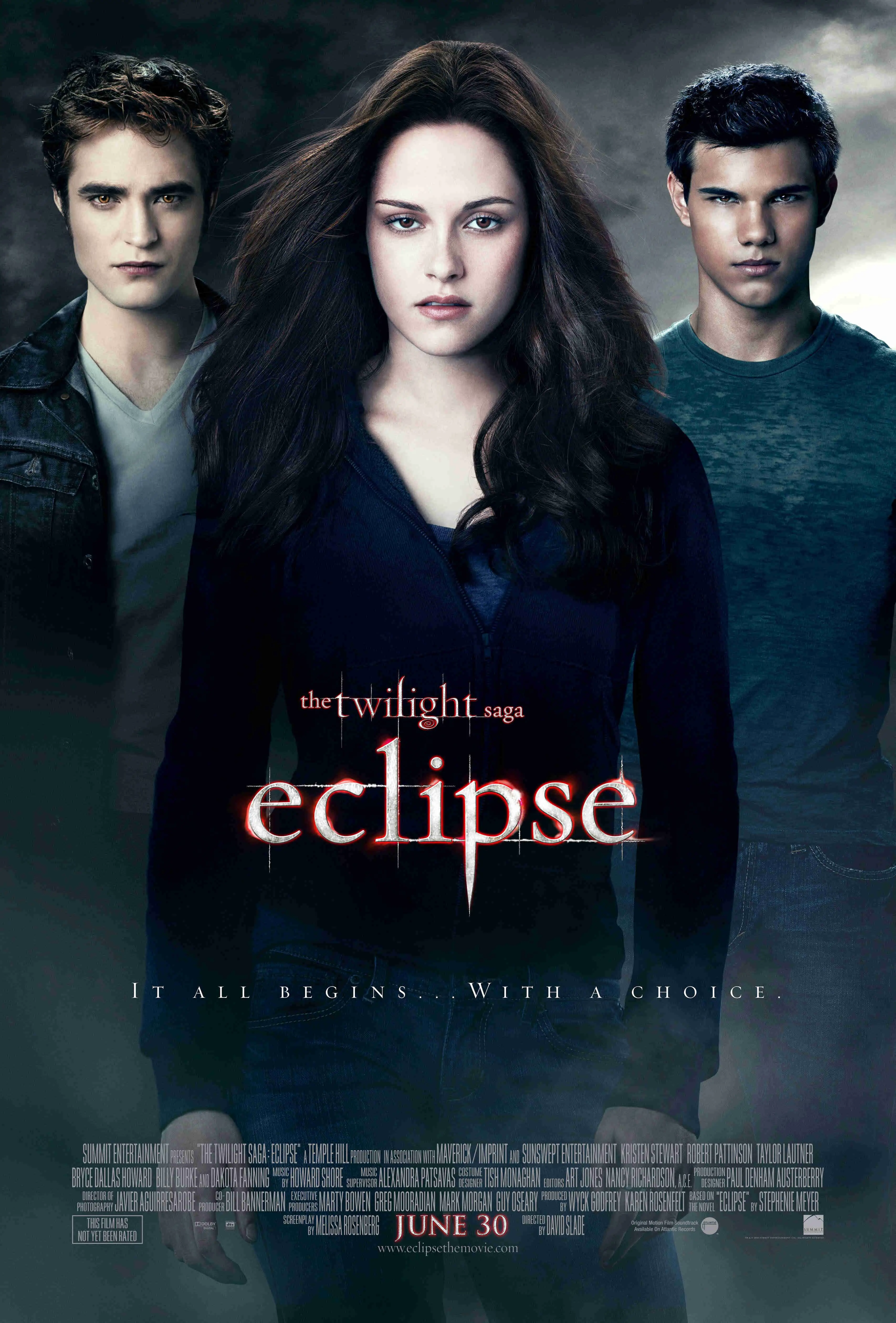
I am of the not-entirely-humble opinion that this movie exists for the sole purpose of advancing the love triangle forced briefly eluded to in the previous movie.

Okay, yeah, so a bad vampire from the first movie comes back and tries to eat Bella, but this subplot could have easily been touched on without the sickeningly forced and mushy tension between Edward and Jacob.

Save me!


Movie #4: Breaking Dawn Part 1

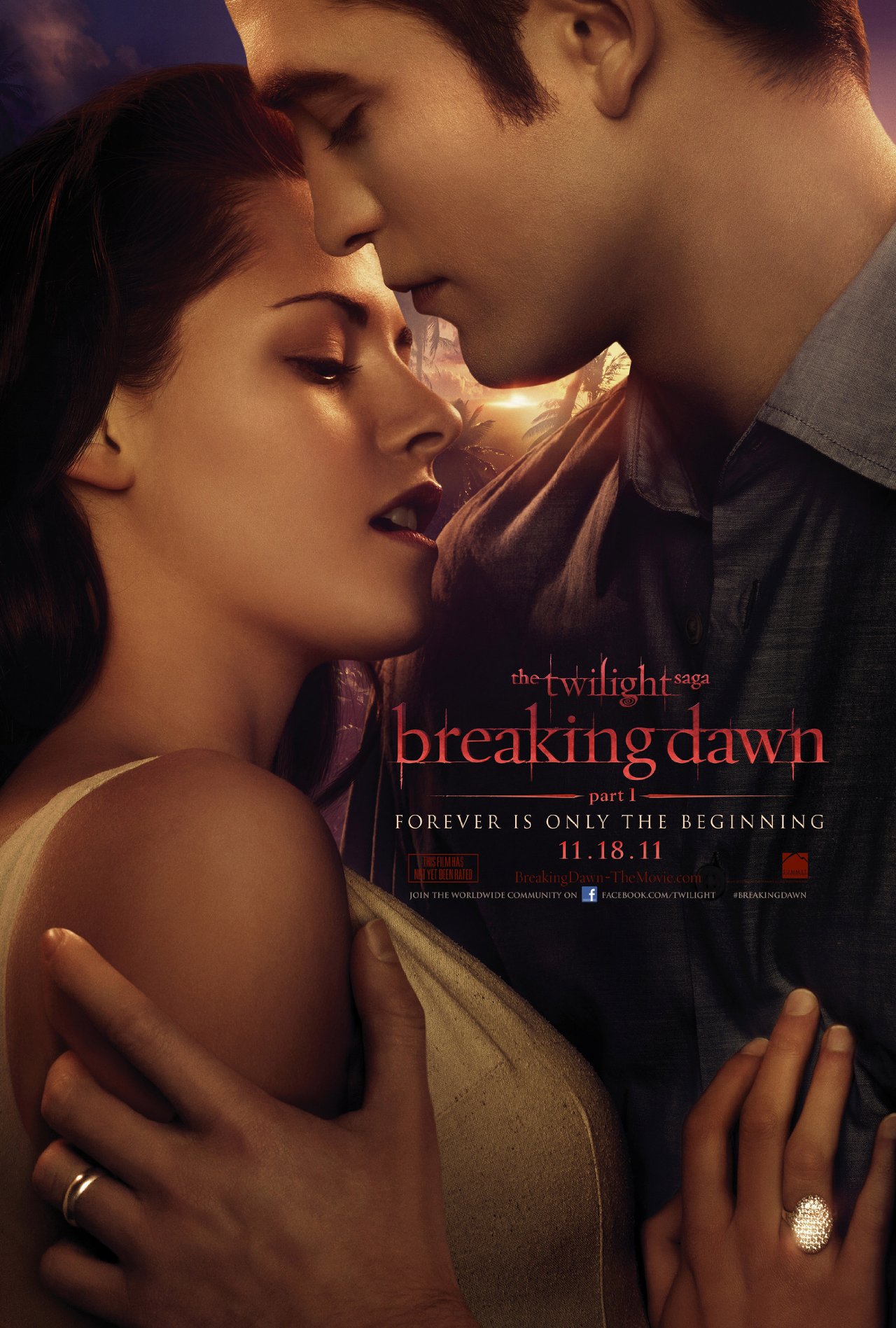
We've suffered through the last three movies to get here, and Bella and Edward's beautiful and surprisingly human wedding makes the journey worth it.  But their honeymoon turns upside down when Bella gets pregnant with a half-undead child...which shouldn't be possible, but we'll let that one slide for now.
This half-undead baby practically kills Bella, but Edward saves her by turning her into a vampire (and thus the predictions of Alice come true!).  The werewolves aren't happy about this for some reason and plan to attack the vampire's residence, but Jacob enlists the help of several other werewolves to help in defending Edward's family.  And if this whole franchise isn't creepy enough, Jacob discovers that he is destined to marry Bella and Edward's baby...
...whereby he claims some ancient werewolf wright that states that no werewolf can harm another werewolf's mate...even if that future mate is a half-undead kinda-vampire who was born five minutes earlier.  Again, this makes no sense, but whatever.  

As an aside, this is the first franchise to casually redefine "book adaptation" by splitting one book into two movies. This will later be imitated by Harry Potter and the Deadly Hallows and eventually lead to the Hobbit trilogy (three movies from one book).  Thank you, Breaking Dawn.  You've revolutionized the definition of a movie adaptation.  Where would we be without you?  One Harry Potter and two Hobbit movies short, to be sure.


Movie #5: Breaking Dawn Part 2

Hey, guess what? Bella's a vampire now! 
But the real problem comes when the Volturi over in Italy find out about Edward and Bella's kid...because apparently it's a crime to turn a child into a vampire in the vampire world...? 

Well, whatever, they spend the majority of the movie gathering a vampire army to fight the Volturi in an epic battle that is actually really cool...but which never actually happens...? 

Anyway, Bella and Edward end up living happily ever after with their kid, who will later grow up and marry Jacob, thus creating the first every half-undead/werewolf relationship in undead history!

Which leaves me with questions like:
~Will Jacob live forever too?
~Will Renesme try to turn Jacob into a vampire?
~If so, what would happen to Jacob?
~Will their whole relationship be really weird for Edward and Bella since they went to high school with Jacob?


BTW, this is probably the best of the 5 movies in terms of production quality.


Movie #6: 50 Shades of Grey

To date, this is the only Twilight movie I haven't seen.  Nor do I really want to see it...

...oh wait.  Wrong franchise.  My bad.

Well, not entirely since it was originally an erotic Twilight fanfiction series.

Sadly, there's literally an erotic fanfiction piece for almost every popular book series and movie franchise, including The Hobbit, Divergent, and Lemony Snicket's Series of Unfortunate Events.  I know this only because I've spent some considerable time perusing fanfiction websites and it can be hard not to accidentally stumble upon these rather disturbing pieces of fanfiction.
 The only difference here is that E. L. James was the only one (I know of) who actually got hers published.


So, next time you read the FSOG books or see the movie, think of Bella and Edward.


Sunday, May 3, 2015

The Water Diviner

During my final semester at the community college, I chose to take a class on the World Wars as an elective.  I've been fascinated by World War 2 history since I was eight years old thanks to a preview for an Anne Frank movie I saw on TV.  But I didn't know a whole lot about World War 1 until I took that class.

That being said, my biggest criticism of textbooks is that they tend to focus only on famous battles and generals and that dude who took down the Ottoman Empire with a toothpick (that' s obviously an exaggeration).  Nobody learns about the farm boy who went to war and got hit by a grenade of the young pilot who lied about his age in order to get enlisted.  So when movies about lay peoples' war experiences come out, I get really excited.

Flash forward to April 2015.  My film school buddy came to class raving about a newer movie called The Water Diviner.  She wouldn't tell me much (she's not one to spoil movies for anyone), but she did say that there were war-related scenes and that they were not glossed over as so often happens in the movies.  So, in order to celebrate the end of a long (and slightly stressful) work week, I went and saw it.

www.itunesitalia.it

The Water Diviner is a bit of a deceptive title as hardly any of the movie has anything to do with actually finding water.  We get a scene at the beginning of the movie showing Joshua Connor (Russell Crowe) finding water in the middle of the Australian wilderness.  Shortly after that we learn that Joshua has three sons who fought for the British Army during World War 1, all of whom never returned home and are presumed (keyword being "presumed") dead.  As a result of this, there is tension in the Connor household summed up when his wife cries, "You can find water, but you can't even find your own children."  This and a tragic event make Joshua set out on a quest to find them. After all, finding the remains of your three sons can't be that much harder than finding water in the bone-dry wilderness of Australia...can it?


Brits and Turks Agree to Help Each Other on Gallipoli
civil.by

Turks Help Joshua Find Arthur
http://www.londragazete.com
The movie is unique in that it is a splendid mixture of cultures as Joshua travels to Turkey, meets a Turkish widow, and crashes the army base at Gallipoli in search of his sons.  British/Australian Christians and Turkish Muslims work together to locate the remains of their troops lost in combat, and neither side is portrayed as the bad guy.  Both sides have suffered heavy casualties.  Both sides have dead who are unaccounted for, who lie in unmarked graves strewn across the Gallipoli battlefield.  The British ask for assistance from the Turks.  The leader of the Turkish army agrees to help Joshua find his sons.  Later, when they're captured by invading Greeks, the leader of the Turkish army saves Joshua's life by claiming that he is an Australian prisoner (and, therefore, an ally of the Greeks).  Joshua returns the favor by saving him from the Greeks who are going to execute him.


Henry, Arthur, and Edward at War
www.cineclandestino.it


At the same time, The Water Diviner is a tribute to family.  Joshua will stop at nothing to find his boys and bring them home (or what's left of them).  He risks bullets, bombs, the British Army, and angry Turkish brother-in-laws to find the place where they are thought to have died in battle.  On the same front, the brothers (depicted in a series of flashbacks) remain loyal through childhood and into the battle.  When a dust storm comes crashing down on them, they refuse to leave each other behind.  When one gets injured by a grenade, the others rush to his aid (which is how they got killed in the battle).


www.glendalenewspress.com
Throughout the film, the closeness of the boys to their father (and their father's love for them) can be clearly seen in everything they do and say.  Flashbacks show a devoted father reading to his children from Arabian Nights, a scene which is mirrored as Joshua sits and reads the book beside Edward and Henry's graves in Gallipoli later in the film.  You already knew they were dead, didn't you?  It's in the preview.


Another thing which makes The Water Diviner unique is its depiction of war.  Many times, death in media is depicted quickly and relatively painlessly (with the exception of that kid who gets drilled in the head in American Sniper and every victim in every Saw movie ever made).  But, on average, war movies tend to do either one of two things: make us hate those whack-jobs who just want to kill innocent people overseas or make us want to join the army.  Most recently with American Sniper and now The Water Diviner, movies have finally started to be made that cast a more accurate light on war.  The reality is that war is ugly.  War is crawling around in mud with someone else's blood all over your face.  War is getting your arm blown off by a well-placed grenade and listening to your dying comrade moan for hours or days until they finally bleed to death.  Russell Crowe (who also directed the film) made sure that none of the horrors of Gallipoli were glossed over.  Henry's face is blown off by machine gun fire, and we see the wound in graphic detail in several flashbacks.  Edward's guts are practically hanging out, and we listen to him groan for at least five whole minutes before he finally dies (although it is implied that this scene takes place over a much longer period of time).  But he's not alone.  All around them, we hear the heart-wrenching moans of the dying -- other casualties left to die of their extensive wounds on Gallipoli.  It is truly horrific and hard to watch.  The Water Diviner knows that, and still refuses to shy away from it.

That being said, Edward's death is one of the most beautiful scenes in the film.  Please don't misunderstand, it's still horrific.  But even as he's dying on the battlefield, his relationship with his brothers is preserved.  He and Arthur (Henry died when his face was shot off) share old memories of things their father said and reference the Arabian Nights stories he used to read to them.  He begs Arthur to kill him -- he's dying anyway, why prolong the suffering when the result will be the same.  Arthur is resistant at first, but later pulls a bayonet over and does the hardest thing he'll probably ever do -- ends Edward's suffering.

I didn't even cry when Thorin died in Battle of Five Armies.  But I cried when Arthur pulled the trigger.

Despite it's hopelessness (as we spend at least half the movie believing that Arthur perished with his brothers at Gallipoli), the movie still gives us little rays of hope to cling to.  The color palette is full of vibrant color, everything from crystal blue seas to stunning orange sunsets.  My film school friend said it felt like the bright colors were symbolic of the hope in the story.  And when I thought about it, I had to agree with her.  Joshua never gives up hope that he will reach Gallipoli, find the remains of his children, and later find Arthur and bring him home.

These are the type of movies, and the type of scenes, that remind me why I want to be a filmmaker.

Other than the grotesque death sequences and the occasional bomb, gunshot, and slit throat, The Water Diviner is surprisingly clean.  Soldiers are shown bathing on the beach, some of whom are naked, but nothing graphic is shown.  A few uses of d---, h---, bastards, and a few others, but no f-bombs or misuses of Jesus' name.

Overall, definitely a movie worth watching!

Tuesday, February 3, 2015

Transcendence

Where do I begin?

I can't decide if I liked Transcendence or not. 

The movie,  in and of itself, is gorgeous.  Every single shot is framed beautifully.  There is no doubt on my mind that director Wally Pfister gives a lot of attention to the visual aspects of his movies.

That being said,  Transcendence was terrifying.

Most of us have probably heard theories about the demise of the technical age.  People have been planning for this for years,  the most recent example that I can think of being Y2K.  

Some say a solar flare will knock out the grid.  Some say one of our enemies will pull the plug on us and leave us in darkness.  Some say it will be a conspiracy spearheaded by an overly controlling government that will cut off our power. Transcendence says that we'll bring it on ourselves.  That in our efforts to enhance ourselves through technology,  we will destroy it.

Early on,  we meet Will Caster and his wife Evelyn (played by Johnny Depp and Rebecca Hall respectively), who have devoted themselves to creating a sentient computer, one that can function like a human and think for itself.   So far, they have been successful in the form of PINN, Physically Independent Neural Network.   However,  research continues at various science labs across the country to perfect the program.

Tragedy strikes when Will's affiliate labs are attacked, and he himself is shot at a convention.   Matters are further complicated when it is discovered that the bullet that shot Will was laced with Polonium, and Will only has a month to live.

Will decides to spend the last few weeks of his life home with Evelyn.  Evelyn, however,  isn't ready to accept Willis death so easily.   After finding out that one of their fellow scientists had successfully uploaded a monkey's consciousness to a computer,  she tries to convince Will and their friend Max (Paul Bettany) to attempt to do the same with Will's mind.  Max doesn't like the idea,  but Will decides it's worth a try (more for Evelyn ' s sake than his desire for the technology to work).

After Will dies in his sleep,  it appears that the process wasn't successful.   But as Evelyn and Max prepare to shut down the program,  they are surprised when a message appears on the screen: Is anyone there? 

Evelyn is convinced that it's Will, but Max has his doubts and insists they shut down the program anyway.  Furious,  Evelyn tells him to leave.  She uploads Will to the Internet,  and he leads her to a remote town in New Mexico where he instructs her to build a gigantic laboratory with the world's biggest array of satellite panels from which he can draw power.

Meanwhile,  Max is abducted by a group of anti-technology people called RIFT, Revolutionary Independence from Technology.   These are the guys behind the attacks on the science labs and for poisoning Will.  Their leader,  Bree (Kate Mara), tells him they agree with his misgivings about uploading humanity to computers, except they're taking it a step further by trying to end human dependence on technology altogether.   Max resists at first,  but later joins them.

Man vsComputer

What's interesting up to this point is the difference between the human-Will and the computerized-Will. 

Human-Will appears selfless,  and his only purpose is to aid humanity through his research and technical advancements.   When it comes down to a decision between spending the remainder of his life at work or with Evelyn,  he chooses Evelyn without question. 

Computerized-Will, on the other hand,  seems intent on conquest from the get-go.  He heals people with his advanced technology,  but in doing so he implants a bit of himself into them.  This way,  he builds himself a pseudo-zombified army with superhuman strength and the ability to heal, all controlled by his main computer systems.

Despite her love for Will, Evelyn is appalled by this.  She tolerates it for a while, but after Will reanimates his army after they are killed by RIFT guys,  she decides enough is enough.

At RIFT headquarters,  Max explains that he never believed it was possible to upload Will, himself,  to a computer.   He points out how the computerized-Will seems self-serving and controlling,  unlike the human-Will.   He convinces her that it's never really been Will in the computer. 

She agrees to help them shut him/it down.

The End...?

This is where things started getting really confusing for me. 

Evelyn injects herself with a computer virus that will shut down the computerized-Will and every network he's touched...which is everything.  Then she goes back to Will and asks him to upload her into his system.  During the ensuing battle between RIFT and Will's techno-zombified army,  Evelyn is wounded.  At first it doesn't seem like the computerized-Will cares, but later he tries to heal her (thus infecting him with the virus).  At the same time,  Evelyn says that she can "see" now.   Everything Will has done has, apparently,  been for good, to bring peace on Earth and save the planet.   Evelyn says she's sorry she didn't believe it was really Will, and they are later found dead in each others arms. 

My thing is, I'm still not really convinced it was really him.

As mentioned earlier,  the change in Will's human personality to his computerized personality is noticeable.   Human-Will puts Evelyn and her needs before his own.  Computerized-Will,  although he means well, is only concerned about accomplishing his goals.  

Human-Will, when given the choice between spending his last month at work in the lab or with Evelyn,  chooses to be with Evelyn.  There's a beautiful scene near the beginning where she's asleep in a lawn chair in their garden after working outside all day,  and Will comes up to her and carefully drapes a blanket over her.  Despite the fact that he's the one who's dying,  I think he is sad for her, that she will have to watch his decline and live on without him.

Computerized-Will is all about himself from the get-go.   "I need more power" he says almost right off the bat.  At first their lab in New Mexico is just big,  but as the film progresses it steadily gets bigger and bigger until it's insanely huge, even for a movie.  To top everything off, he doesn't understand why Evelyn isn't as excited about all of his advancements as he is.

"I don't understand," Will says.  "This is the future. "

"This is not our future, " Evelyn replies.   "You're not here with me."

"You've changed.  Have you fallen out of love with me?" he asks.

"No," she says.

The differences in Will's human and computerized personalities are so different from each other that I found it really hard to believe the computerized-Will was really Will to begin with.

Computers can't feel emotions.   They can only accomplish the tasks they are given.   And that is exactly what computerized-Will does.

However,  some would argue that Will really is himself because he really loves Evelyn.   But here's my argument against that: In the 8th (and most disturbing) season of Doctor Who, the Doctor states that true love isn't an emotion, it's a promise.  It makes sense,  doesn't it?   Most wedding vows says, " I take you to be my spouse,  to have and to hold from this day forward, in good times and bad, rich or poor,  in sickness and in health,  till death do us part."   Although love is important to the equation,  we aren't promising to have mushy feelings for each other all the time.   We're simply promise to stick together through everything.  

A computer can keep a promise, but it cannot feel love even if it wanted to.

And, to top off my argument,  one of the first things Will says when they upload him to the computer is, "I can't feel anything."

Saturday, March 29, 2014

Noah: A Splash of the Apocalypse

The movie Noah opened in theaters at roughly 8pm Thursday night (March 28th, 2014).

Anti-Noah petitions have been showing up all over Facebook...for the past two months.  Two months.

The movie opened on Thursday night.

It has been protested for two months.  

Friday morning, I logged onto Facebook to find that one of the Christian pages had posted an advertisement for Noah.  It very innocently stated, "Noah hits theaters tomorrow".  I got on at 9am, and there were already 78 comments on the post bashing Noah, calling it a mockery, and expressing disappointment that this Christian site would advertise this horrible interpretation of the classic Bible story on Facebook.  Seventy-eight.

Did I already mention that the movie opened at 8pm Thursday night?

PluggedIn hadn't even reviewed it yet!

My opinion was, "Don't be so quick to judge something you haven't seen."  

Some agreed with me.  Some continued to rant.

So, I went to see Noah this afternoon.  

It was also my first Russell Crowe movie.

Here's Noah in a rather large nutshell:

In the Beginning, God created the Heavens and the Earth.  He eventually created man in His image, but they sinned and were cut off from God.  Adam and Eve had three sons, Cain, Abel, and Seth.  Cain killed Abel, and Cain's descendants spread out and pillaged and plundered like evil people.  Seth's descendants were good and relatively peaceful people who tried to counter the evil of Cain's descendants.  Fast forward some hundreds of years; young Noah and his nomad father are innocently out in the wilderness when a group of Cain's not-so-cool descendants arrive.  They kill Noah's father, but Noah is conveniently hiding behind a rock, and therefore the line of Seth is not ended as previously assumed.

Meanwhile, as humans began to spread out over the Earth, a group of angels got together and jointly decided that they were going to go to Earth and help the peoples out (with what, I don't know).  God was somehow angered by this, so He punished them by causing them to get trapped in stone encasements when they hit Earth.  They are now mutilated creatures of the Earth, which the movie refers to as fallen angels in the opening credit sequence.  Since then, they have been hunted down by men (whether these are the descendants of Cain or Seth is unclear), and the only person who defended them was Methuselah (yes, the same guy who lived to be over 969 years old).  They are now living, more or less, in seclusion in a barren wasteland at the base of a mountain off in the middle of Nowheresville. 

Flash forward.  Noah, now a husband and a father, lives in another barren Nowheresville.  While he and his two eldest sons, Shem and Ham, are gathering food, they encounter some of Cain's descendants who are hunting.  This being an adventure film, Noah kills them, and he and his sons give the dead animal a proper funeral.  Ham seems unhealthily interested in the fact that Cain's descendants eat animals, and this concerns Noah. 

That night, Noah has a freaky dream.  He sees himself standing in a muddy pile, but instead of water intermingled with dirt squishing between his toes, he finds his feet covered with blood.  He looks up and sees a mountain, which happens to be the current residence of his grandfather, Methuselah.  Seconds later, he's underwater, surrounded by dead and decaying human remains. 

So, Noah packs up his family and they all head out to visit dear old granddad Methuselah at his mountain residence.  Which isn't as easy as it sounds.  They have to pass through Cain-people territory to get there.  They're making good time until they come upon the remains of some people who have been butchered by Cain's descendants.  The only survivor, a young girl named Ila, is wounded and feverish.  Noah and his family adopt her in an act of rescue as they are all suddenly chased by more Cain-peoples who have been lurching in the area.  Their chase leads them into the Nowheresville occupied by the fallen angels, who then spring upon everyone, kill the Cain-people (it's effortless for them as they're huge and covered in solid rock), and dump Noah and his family in a pit to die.

One of them, however, helps Noah and his family escape and guides them safely to Methuselah's mountain.  There, it is revealed that Noah is to build an ark to save the animals (and his family) from the coming destruction.  After some convincing, the fallen angels agree to help Noah in this endeavor.  

And God makes a river explode from the ground, and it caused a forest to grow out of Nowheresville, which then provides them with the material to build their ark.  Yay!

Ten years later...I guess Noah can get a 140 year job done in 10 years with the help of the fallen angel rock peoples. 

Ila and Shem are deeply in love, but Ila's childhood wound has left her barren (not a good situation for someone who's supposed to help repopulate the Earth).  Ham is jealous because he doesn't have a girlfriend, and Japheth (who was a baby when this whole thing began) is old enough to help with the ark building and food gathering and such.  The whole thing is disrupted when a group of Cain people show up, led by Tubal-cain (did we mention that Tubal-cain murdered Noah's dad at the beginning of the movie?).  Tubal-cain and company camp on the other side of the miracle forest, and promptly break out in chaos.  

The ark is completed on schedule, and the rain starts pouring.  The Cain peoples, realizing that what Noah mentioned about impending doom by flood is probably true, set out to take the ark.  Noah hides his family in the ark with the animals, and fights off the Cain peoples with the help of the fallen angel rock people.  Water explodes out of the ground, and the flood comes.  Everyone outside is washed away, except for Tubal-cain who has managed to stow away on the ark with the animals.

In the middle of all of this, Ila discovers that she's pregnant with Shem's child, a miracle in and of itself.  But, for whatever reason, Noah has come to the conclusion that God never meant for man to survive at all, and therefore Noah and his family are to be the last people to walk the Earth.  In light of this and the news of Ila's pregnancy, Noah is determined to kill her baby.

Nine months later...there're still on the ark.  It has stopped raining, and everyone is beginning to hope that they could find solid land to live on soon.  Shem and Ila prepare to take off on a raft to escape from Noah, but Noah destroys their raft, and Ila goes into labor (perfect timing).  Surprise, surprise, surprise, Ila has twins.  Twin girls.  Noah is about to kill them, but then stops and says, "I can't do this."  At that moment, the dove arrives with an olive branch.

Tubal-cain tries to kill Noah, but Ham eventually manages to kill him.  End of corruption.

They land, make lives for themselves, Noah has a period of depression, and Ham leaves home (thinking that he's too violent and corrupt himself).  Noah eventually comes back to himself, and bestows his blessing on Shem and Ila's children.  There's a cool explosion thing in the sky, God's sign of approval, which pans out into a really cool and vibrant rainbow.

Roll credits.

Yeah, that was a huge nutshell.


Here's my opinion of Noah, in a much smaller nutshell:

I do not consider my 2 hours and 17 minutes to be wasted.   

I didn't think it was as bad as certain petitions made it out to be.  However, I'd classify it as one of those films that are really, really good, but need different titles.  It was a version of the Noah story.  It was more like a post-Apocalyptic version of the Biblical account.  I did find it interesting, though, that they showed Methuselah being alive at the time (I think I've seen timelines that show that he would have been alive during Noah's lifetime).  The film also showed the rest of mankind as being extremely corrupt, which is Biblically accurate (not just Evan Almighty, "Hey Weirdo with a Beardo!  How's the ark building coming along?", but serious, honest to goodness corruption).  

But, be warned; Noah is rated PG-13 for a reason.  

Borderline stereotypical blood-splatter (Game of Thrones fans know what I'm talking about) abounds in the film; it's like an ejective explosion of blood that spurs out of every single wound in an almost unrealistic manner.   

In the midst of all the corruption, there's actually no overly sexual content or nudity.  Well, okay, we see Noah lying naked on the beach from a distance, but nothing explicit is shown.  Also worth noting is that Adam and Eve are shown naked in the Garden of Eden, but their anatomy is masked by a sort of glowing angelic light that envelopes their bodies, and again we don’t see anything explicit.  There is an awful lot of kissing between Ila and Shem, though.  The most that is shown is a bare stomach and bare shoulders.  Nothing explicit.  Nothing overtly sexual.  

Noah is mercifully void of harsh language problems.  Tubal-cain uses the d-word twice, but it makes sense in the context of the story (it's in his catchphrase).  It was such a relief to get through a film without being bombarded by foul language. 

But, the most important thing to remember is this:  It's an interpretive version of a classic Biblical account, NOT a word-for-word retelling of the account itself.


Why are Christians so up in arms about Noah?

First of all, not all Christians hate the movie. 

I believe I am the first of my Christian friends to have seen Noah.  Those I have talked to agree that the film should not be judged until viewed.

Most of the anti-Noah rants I've read were written by people who haven't seen the movie, but have read about it (whether it be from Glenn Beck or someone else).  While I respect Mr. Beck's opinion, I still hold my own; Noah wasn't as bad as people made it out to be.

Those who are not Glenn Beck are concerned about Biblical inaccuracy, which is actually a valid point.  But, sometimes we Christians can get a little...oh, how shall I say this?...out of control with our feelings and convictions.  While there is nothing wrong with our convictions, there comes a time when we overstep even our God-appointed duties to speak up.  

Noah is the perfect example.

When have we overstepped the realms of sanity?

When we start threatening to burn people at the stake for not agreeing with our feelings about something.  (True story, there's an article on FB stating that "[We] should consider burning at the stake any Christian leaders who endorse this movie").  I consider that to be a bit radical (and not in a good way).  Especially since Jesus, himself, commanded us numerous times to love our enemies.  The above article doesn't sound very loving or Christ-like.  It sounds more like Fred Phelps than Jesus.

For all of those who have been quoting the Bible in defense of your Noah-hating/burn-at-the-stake comments, here's a Bible verse for you:

"But, I have this complaint against you.  You don't love me or each other as you did at first!" (Revelation 2:4, NLT)

If we are going to share the truth (in this case, our feelings about the inaccuracies in Noah), we should spend less time hating and boycotting the film, and spend more time doing research so we can calmly and maturely share our thoughts and feelings with those who may not know the truth.  Trust me, nothing turns someone off like, "I'm boycotting the movie because I heard from Bill who heard from Bob who read on Facebook that the movie sucked."

By the way, there's a boycott on FB now.  I'm one of the few people who have posted something not-negative about the movie.  I've probably just set myself up for major bashing, but that's okay.  It won't change my opinion.


Should Christians see Noah?

As I told my FB friends this evening, I think those of us Christians who know what we believe and have a firm foundation in Christ are safe seeing it, if for no other reason than intelligent discussion (What was Biblically accurate? What was interpretation or creative license? etc.).  Others who are new to Christianity or aren't as firmly grounded in their faith should be careful.


Okay, so what was Biblically accurate about Noah?

1. The Corruption of the Peoples

"Now God saw that the earth had become corrupt and was filled with violence.  God observed all this corruption in the world, for everyone on earth was corrupt."  (Genesis 6:11-12, NLT)

Evan Almighty fans and people who have grown up on children's classic Bible stories may think that "corruption" means people just not loving God and teasing Noah for building a huge boat in the desert.  I once saw a kid's claymation version that portrayed "corruption" as houses bouncing around (assuming the occupants were chaotic and unruly).

In reality, think Sodom and Gomorrah...tens times worse.

That is my new opinion of the word "corruption" in this context.

Things got so bad that God, the infinitely merciful and loving creator of everything, decided to wipe them out and start over.  Remember, Sodom and Gomorrah were bad enough that God rained fire down on them to destroy them.  This is the entire world we're talking about.

So, technically, the movie's portrayal of the world's corruption is probably pretty accurate.  

The Cain peoples are unruly and murderous.  There's a rather disturbing scene where Noah goes to their encampment to find wives for Ham and Japheth, and he witnesses people trading their wives and daughter for food.  Some men manage to knock over a fence and get their hands on a donkey, and literally rip the poor thing to shreds while it's still alive.

By the way, no real animals were hurt in the making of this movie, if that makes the PETA people feel better.


2. God's Mercy 

Rewind to when God looked down and saw that the peoples of the Earth had become corrupt and He decided to wipe them out and start over.  Now, He could have just tossed a fiery bomb at us and blown up the planet, but He didn't.  Instead, He told Noah to build a big boat and put two of every animal in it so in order to preserve life.  Noah, his family, and the animals on board are to repopulate the Earth after the flood, and those God's creation isn't entirely annihilated, only purged of corruption.

"So God said to Noah, "I have decided to destroy all living creatures, for they have filled the earth with violence.  Yes, I will wipe them all out along with the earth.  Build a large boat from cypress wood and waterproof it with tar, inside and out [...] Look!  I am about to cover the earth with a flood that will destroy every living thing that breathes.  Everything on earth will die.  But I will confirm my covenant with you.  So enter the boat — you and your wife and your sons and their wives.  Bring a pair of every kind of animal — a male and a female — into the boat with you to keep them alive.””  (Genesis 6:13-14a, 17-19, NLT)

Although the name of God is never actually spoken in the movie, and God is generally referred to as "The Creator", it was still clear (at least it was to me) who we were talking about.  God, the Creator of all things.  The God who breathed life into everything and brought the world into existence just by speaking.  The same God who saved eight people and two of every animal is the same God as the one who sent His only Son to die on a cross for our sins.


3. Methuselah

While this is not actually mentioned in the Bible, I have read articles and seen charts that indicate that Methuselah would have been alive at the same time that Noah was building the ark.  So, it was kinda cool to see Methuselah pop up once in a while in the movie.


4. The Flood

Duh...


5. The Rainbow

...another "duh".  Although, it was shown in a very unique and vivid way.  


6. Noah Getting Drunk Afterwards

This is one of those things I wish they'd left out, but they put it in.  I guess most movies based on other text (whether it be Lord of the Rings or The Bible) have those scenes where we're like, "Well that's the one accurate part I wish they'd been inaccurate about."  In context, it sort of has a purpose, though.  

Again, while this is not actually mentioned in the Bible, the movie suggests the concept that Noah was so emotionally distraught after watching all of humanity die that he suffered a sort of nervous break down that may have caused temporary insanity.  This may explain why, in the movie, he convinced himself that God wanted him to kill Ila and Shem's daughters.  This may also explain why he goes off to a cave and gets drunk once everything is dried out and they're back on solid ground again.  The Bible doesn't indicate this, but it is still an interesting concept.


Other Things Worth Mentioning

1. The Watchers

Whoa, whoa, hold on!  The what???  

Okay, so I kind of forgot to mention that the movie also referred to the stone giant "fallen angel" peoples as The Watchers.  

I first heard about the Watchers in one of my favorite Christian novels, Dragons in Our Midst.  In those books, they are portrayed as fallen angels who have married humans, who are purely evil and are trying to take over the world.  In light of what I've read in those books, I was interested to see the Watcher's incorporated into the Noah movie.

In the movie, however, the Watchers are portrayed as remorseful angels who got stuck on Earth after coming down to help mankind.  They hoped and prayed for years that God would forgive them, and let them come back to Heaven, but to no avail...yet.

My thoughts: It's a Return of the King moment.

Side trip: In Return of the King, there is mention of an army that Isildur rallied to aid them in the battle against Sauron.  But, this army fled at the last minute and hid out in the mountains.  So, Isildur cursed them, so that they could never sleep until they had fulfilled their oaths.  Aragorn goes to rally the dead army to aid Rohan in defeating the armies of Sauron on the Pelennor Fields because he's Isildur's heir, and therefore the only living person with the right to rally them, and the ability to set them free.  They eventually agree to follow him into battle on the Pelennor Fields, and after the battle is won, Aragorn declares, "I hold your oaths fulfilled," and the dead army can finally actually, well, die.

It seems like the same kind of thing here.  God allowed them to be stuck on Earth for a time.  They said they wanted to help the humans, but the humans have hunted them down and killed some of them, so they gave up and hid in the wilderness.  They finally help Noah build the ark, and - although it's not said in the movie - I can image God saying, "I hold your oaths fulfilled," before He allows them to break free of their stony bodies and return to Heaven.  Again, there is no evidence of this in the Bible, or in the movie.  But, it is a concept.

Another thing about the Watchers: Genesis 6 mentions the Nephilim, who were apparently some kind of fallen angels that mated with humans (or were the Nephilim their children?).  Regardless, the Nephilim were giants, and Genesis clearly states that they were around at the time of Noah, and after the Flood.  The biggest evidence that the Nephilim were still around after the Flood is when the Israelites go to spy out the Promise Land, and come back with reports of freakishly tall giants.  So, the argument could be made that if the Nephilim were actual fallen angels (or the descendants of fallen angels), they could return to Earth and start all over again after the Flood.  

So, it is possible that this stone-encased "fallen angels" are the filmmaker's interpretation of the Nephilim?  It would make sense, since they're giants.  Food for thought.


2. Sin

Most non-Christians are of the opinion that man is basically good.  They’ll believe Pandora’s Box before they’ll admit that man brought sin into the world (as stated in Genesis). 

Noah is very adamant; man brought sin into the world when Adam and Eve disobeyed God and ate the forbidden fruit.    

I applaud these guys for not shying away from the issue!

Of course, they also take it to the extreme where Noah assumes that God means to forever rid the world of mankind because they were the ones who broke the rules to begin with.  This thinking leads to the almost murder of Ila and Shem's babies, but Noah eventually comes to his senses and realizes that he and his family have been preserved in order to repopulate the Earth after the Flood.


My Biggest Problem

Yes, I have one big issue with Noah.  And it is this; they gave Methuselah way too much power in the movie.

He's portrayed as some sort of magician who can work up magic sleeping potions and make you fall asleep by breathing on you.

The whole thing is most evident concerning Ila's pregnancy.  He says he's going to give her his blessing.  What he does is tough her stomach, and it is implied that she is magically healed of her barrenness by his touch.

Before that, Noah's wife goes to Methuselah and asks him to make it possible for Ila and Shem to have children.  She doesn't even bother checking with God.  She just goes to "all-powerful Grandpa Methuselah".  And he doesn't try to say, "Yo lady, God's the guy you should be asking."  All he says is something like, "This is probably going to end tragically for you guys."  Which it almost does.

My point: I really wish they'd have given the power to it's rightful owner, God, instead of making Methuselah out to be an all-powerful magician.


Conclusion

So, Noah was definitely interesting and not a waste of time. 

It was more of a post-Apocalyptic version of the Noah story. If you're expecting a word-for-word retelling of the Biblical account, you'll be disappointed. 

However, Noah was a good, well-made movie in and of itself. And there was some Biblical accuracy in the film (the animals came two by two, God told Noah in a dream about the flood, the other peoples were extremely corrupt, and the rainbow still appeared in the sky afterward). 

I will leave it up to you to decide whether or not to see Noah, in theaters or ever.  I could tell you one way or the other, but that decision really needs to be between you and God.  

If you do go, view it as a twist on a story as opposed to a direct visual interpretation of the Biblical account.  View it skeptically and critically, analyze everything, so that you will be better able to answer when others ask you about your opinions of the film (and you'll be better equipped to tell others the truth about the story). 

 If you don't go, then please, please, please do your research before bashing the film.  Read reviews from valuable sources.  Listen to people who have seen it.  And, above all else, don't start ranting and raving like a maniac (that's the best way to turn people off, I should know).

Either way, we should use Noah as a learning experience, to teach us how to articulate our thoughts and convictions in a loving, Jesus-like way.  If we're supposed to be Jesus to the world, then maybe we should start acting like it.


And, I still did not consider my 2 hours and 17 minutes to have been wasted.